01
Free: 60-minute call and Blueprint.
A working session on your business, then a clear plan of what we would build and in what order, written down for you to keep. No cost, no obligation.
Manufacturing
Once every paper, board and ink bill is checked against the rate you agreed, and every job is costed against its true setup, run and spoilage, you stop quoting below cost and you see real margin by job and customer the same morning, not four weeks late.
The art of the possible
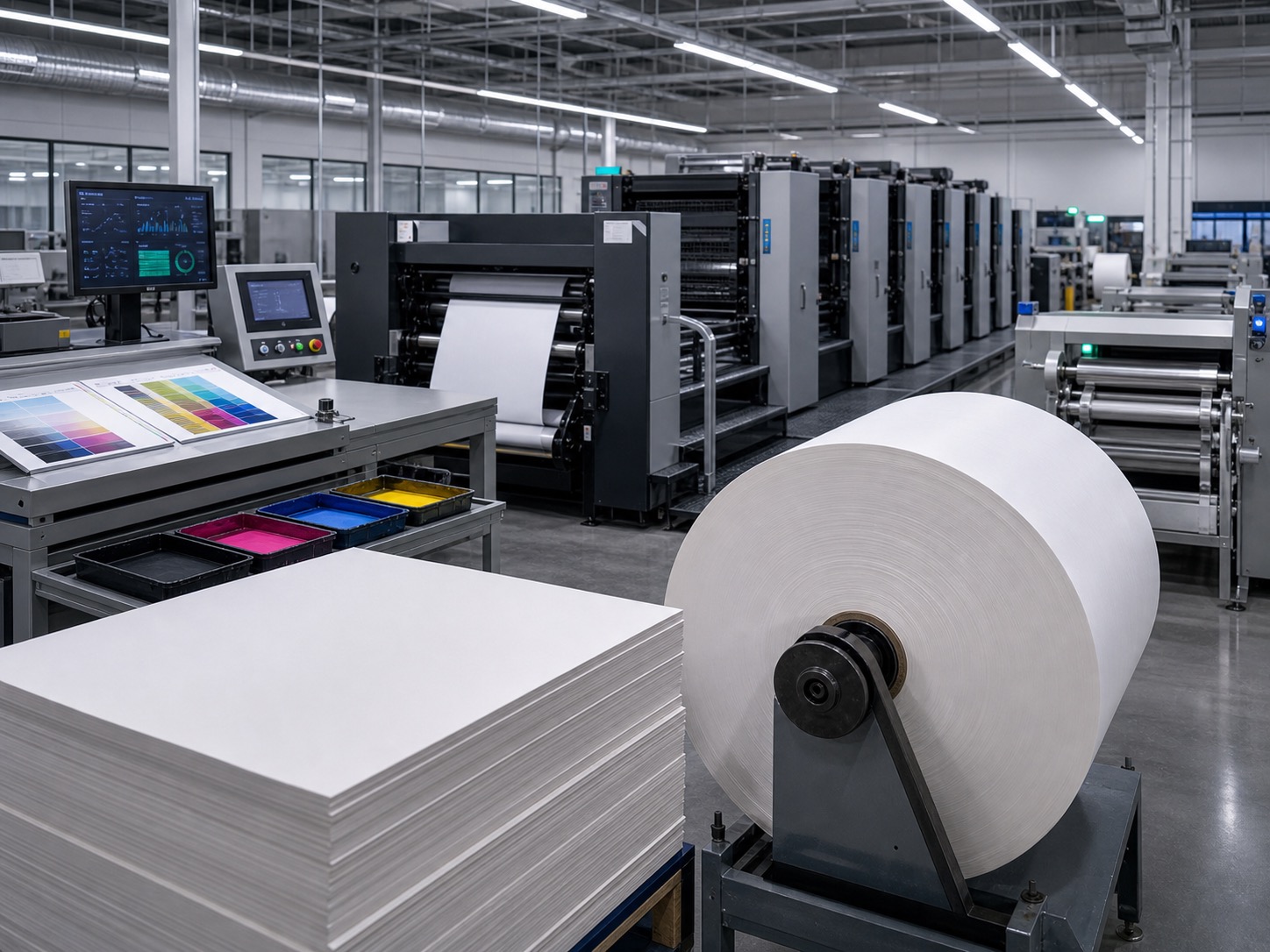
The art of the possible here is not an AI that runs the press. It is the board and ink rate you actually agreed checked against every supplier bill, so the overbilling hidden across hundreds of invoices is caught before payment; wastage and make-ready spoilage tracked by job and machine so the few patterns that drive material loss surface; each job costed against its true setup, run and rejection so you stop quoting below cost; and your true cash, stock and margin-by-job visible every morning instead of at a late month-end. Reliable arithmetic and workflow carry the value; AI is confined to reading messy job tickets, board and ink invoices and delivery challans, and clustering rejection history; and every write that touches a price, a bill or a customer commitment waits for a named person.
The operating reality
Paper and print run on wastage, make-ready spoilage, board and ink that drift in price, and jobs quoted from memory that turn out below cost once setup and rejection are counted. The owner needs material consumption and job-level margin made visible, the leaks across hundreds of supplier and job bills surfaced, and a true cost-per-job and cash position on one screen rather than four weeks late.
By segment
The same industry runs differently across its segments. Here is the operating reality of each, and the builds we would rank first, with why.
Convert pulp or recovered paper into reels and board at continuous scale; energy and fibre cost per tonne, grammage consistency, broke and reject rates, and reel-level yield are the spine, with margin set by a few cost drivers running quietly out of control.
Production logs, the weighbridge, energy meters and the accounting book do not agree; one source-linked layer is what makes cost-per-tonne and yield trustworthy enough to act on.
See what we buildWith the layer in place, the owner can ask which grades, shifts or machines are losing money without waiting three weeks for a manual report.
See what we buildFibre and energy are the dominant cost and small drifts compound at scale; pure arithmetic on consumption against output surfaces the recoverable money first.
See what we buildA drifting energy draw or a slipping yield on one machine is caught in days, not at a month-end close when the tonnage is already lost.
See what we buildPulp, chemicals and power are bought in bulk where a small rate error is large in rupees; checking bills to the rate agreed protects the biggest spend lines.
See what we buildBroke, rejects and grammage give-away are the mill's hidden material loss; tracking them by machine and grade gives the leak a number and an owner.
See what we buildCost per tonne, yield and stock by grade on one live screen is the view a promoter or successor will actually open every morning.
See what we buildThe board and bank packs are rebuilt by hand each month; assembling them from the trusted layer ends the manual scramble.
See what we buildRun a job-shop of estimating, plate-making, printing and binding against per-job quotes; make-ready spoilage, paper wastage, machine-hour costing and jobs quoted below true cost are the spine.
The estimating sheet, the job ticket, paper issue and the billing book live apart; one source-linked layer is what lets a printer compare what a job was quoted at against what it actually cost.
See what we buildOnce joined up, the owner can ask which jobs, clients or machines lost money after spoilage and setup, instead of guessing from the order book.
See what we buildMake-ready spoilage and paper wastage are the printer's recurring leak; comparing standard against actual consumption per job recovers real rupees.
See what we buildA job or client where wastage or rejection drifts is flagged the week it moves, not after a season of below-cost work.
See what we buildPaper and ink are the dominant input and rates move with the market; bill-to-rate checking stops cost creep eroding an already-quoted price.
See what we buildTrue cost per job, setup, run, spoilage and binding, is what tells the printer which work to chase and which to drop.
See what we buildJob margin, machine load and cash position on one screen replaces a picture that only forms at a late month-end.
See what we buildOwner and lender reporting is hand-assembled from job sheets; building it from the trusted layer makes it fast and consistent.
See what we buildPrint and convert cartons, labels and packaging to brand specs at high SKU variety and tight tolerances; multi-process costing, board and substrate wastage, repeat-order pricing and on-time delivery to FMCG and pharma buyers are the spine.
Design, die, print, lamination and conversion data sit in separate places; one source-linked layer is what makes multi-process cost per SKU knowable at all.
See what we buildWith high SKU variety, the owner needs to ask which packs and which clients actually earn after every conversion step, answered in seconds.
See what we buildBoard and substrate wastage across many short runs is the packaging printer's structural leak; standard-versus-actual on each SKU surfaces it.
See what we buildA repeat pack whose wastage or rejection crept up since the last run is caught before another order ships below cost.
See what we buildBoard, film, ink and foil from many suppliers carry rate drift; bill-to-rate checking protects margin on price-sensitive repeat packaging work.
See what we buildCosting across cutting, printing, lamination and conversion is where the real margin per pack is found; tracking it stops repeat orders re-priced from stale numbers.
See what we buildSKU-level margin, delivery status and stock on one screen is the control a packaging supplier to demanding brands needs daily.
See what we buildCustomer scorecards and owner reporting are stitched by hand; generating them from the layer keeps the brand relationship and the bank both served.
See what we buildRun lamination, coating, die-cutting, foiling and binding on job-work for other printers; conversion-charge billing, material-issued-vs-returned reconciliation and machine utilisation against a principal's schedule are the spine.
Job-in, material-issued and conversion-billed records sit in registers and chats; one source-linked layer is what lets the shop see issued-versus-returned at all.
See what we buildThe owner can then ask which principals or processes are billing below cost, instead of finding out at year-end.
See what we buildMaterial issued by the principal that is not returned or accounted is the finishing shop's clearest leak; reconciling both ways recovers it.
See what we buildA process or principal where conversion cost or wastage drifts is flagged early, before thin job-work margin turns negative.
See what we buildWhere the shop buys its own consumables, lamination film, foil, adhesives, bill-to-rate checking guards the slim conversion margin.
See what we buildConversion charge billed against true machine-hour and material cost is the business; tracking it shows which finishing work to keep.
See what we buildMachine utilisation, conversion margin and pending jobs on one screen is the daily control for a capacity-led shop.
See what we buildPrincipal-facing settlement and owner reporting are built by hand; assembling them from the layer makes both quick and defensible.
See what we buildThe whole picture
Front office
How the business is found, sells, and is reached.
Back office
How the work actually gets done, day to day.
Talk to your data
One trusted picture you can read and ask questions of.
How an engagement works
01
A working session on your business, then a clear plan of what we would build and in what order, written down for you to keep. No cost, no obligation.
02
Go deeper on one area, or have us build the software, app or data layer. Fixed price. A focused build ships in weeks.
03
We keep it running and watch over it, as much or as little as you want.
Related industries
A free 60-minute call. No cost, no obligation, just a clear read on what is worth building.