01
Free: 60-minute call and Blueprint.
A working session on your business, then a clear plan of what we would build and in what order, written down for you to keep. No cost, no obligation.
Manufacturing
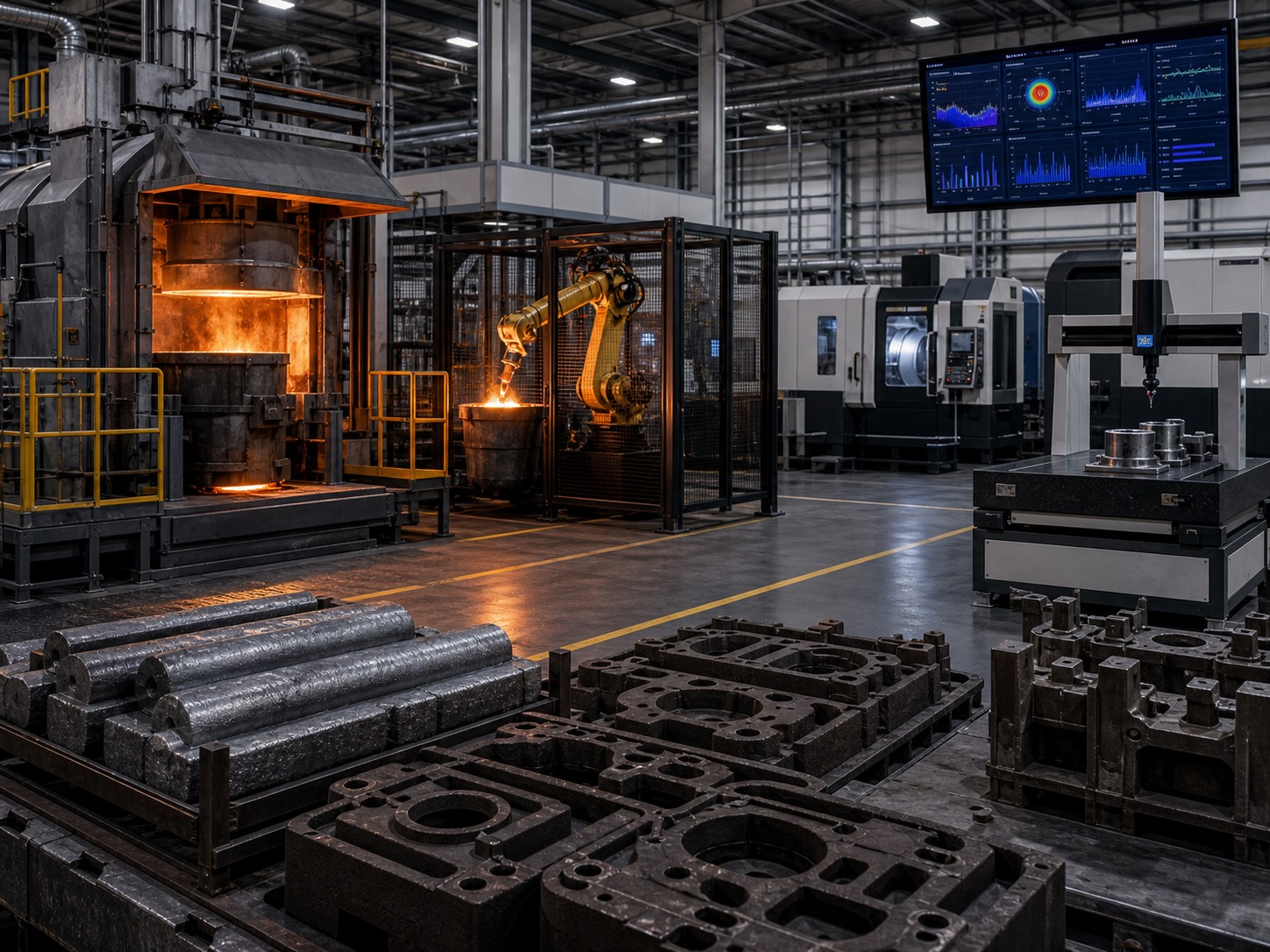
In metals, the margin lives in energy per tonne, yield by heat and the rate on every scrap bill. We make that operating spine visible every shift and governed by a named signer, so the leaks are caught in days, not at month-end.
The art of the possible
None of the wins here are "AI runs your furnace." They are: your true energy and melt cost per tonne visible every shift instead of guessed at month-end, so a drifting cupola or a slipping power factor is caught in days; your charge mix costed and your yield tracked by grade and heat, so the few patterns that drive scrap and rejection surface; every scrap and ferro-alloy bill checked against the rate you actually agreed, so the overbilling hidden in hundreds of weighbridge tickets and invoices is caught before payment; your dies and rolls tracked so a crore-class tool does not fail mid-run; and your true cash, stock and margin-by-grade visible every morning instead of four weeks late. The reliable arithmetic and workflow carry most of the value; AI is confined to reading messy heat-cards and weighbridge tickets, matching a scrap lot to a rate, and clustering rejection history to find root causes; and every write that touches money, a charge decision, a quality release or a customer commitment waits for a named person.
The operating reality
Metals is an energy-and-yield business where cost per tonne is guessed at month-end, charge mix and rejection drive scrap nobody has a number for, and scrap and ferro-alloy bills are paid against hundreds of weighbridge tickets without a rate check. The owner needs energy and melt cost per shift, yield by grade and heat, and true margin-by-grade on one screen, with a named person signing anything that touches money, a charge decision or a quality release.
By segment
The same industry runs differently across its segments. Here is the operating reality of each, and the builds we would rank first, with why.
Melt and cast metal to part specs against a charge mix; energy and melt cost per tonne, charge costing, casting rejection and yield by grade and heat are the spine, and a drifting cupola or slipping power factor can quietly eat the margin.
A drifting cupola, a slipping power factor or a rejection rate creeping up on one part is where margin disappears first; catching it in days rather than at month-end is the foundry's sharpest early win.
See what we buildEnergy and melt cost per tonne, yield by grade and rejection on one live screen replaces a cost picture that only forms weeks after the metal is poured.
See what we buildCasting yield and rejection are the foundry's biggest controllable cost; tracking charge-to-casting by heat gives the scrap leak a number and an owner.
See what we buildPig iron, ferro-alloys and coke are the dominant spend with rates that move daily; checking bills to the rate agreed catches off-rate buying before it compounds.
See what we buildPure arithmetic on charge cost against good castings produced surfaces the recoverable money hidden between the melt and the saleable part.
See what we buildHeat cards, charge sheets and weighbridge tickets are messy paper; turning them into rows is what makes the yield and rate-check numbers possible at all.
See what we buildMetal charged, castings produced and scrap returned must tie out; reconciling them closes the loop on where expensive input actually went.
See what we buildHeavy castings shipped against POs need delivery proof tied to the invoice so dispatched value is billed and collected without slippage.
See what we buildRe-roll billets or process steel into TMT, sections and sheet at volume; burning loss and rolling yield, power cost per tonne, and grade-wise margin on a commodity spread are the spine, where small per-tonne drifts are large in rupees.
On a thin commodity spread, a rise in burning loss or power draw per tonne is caught the week it moves, before a month of rolling runs below cost.
See what we buildCost and yield per tonne by grade on one screen is decisive when margin is a few hundred rupees over a moving billet price.
See what we buildRolling yield and burning loss are the mill's core material leak; tracking billet-in to finished-out by grade gives it an owner.
See what we buildBillets and power dominate cost and rates track the market hourly; bill-to-rate checking protects a spread that a small error can erase.
See what we buildConsumption against finished tonnage compared to standard surfaces the yield and energy money the spread sheet never shows.
See what we buildWeighbridge tickets, billet purchase records and mill logs arrive as paper; extracting them feeds the per-tonne costing and rate check.
See what we buildInput weight, finished weight and scrap must reconcile by heat lot so the mill knows its true yield rather than an assumed one.
See what we buildTonnage dispatched by truck against orders is tied to billing so loaded weight is invoiced and collected accurately.
See what we buildForge and heat-treat components to customer drawings, often on the customer's material; die life on crore-class tooling, process yield, treatment compliance and conversion-charge billing are the spine.
A rejection cluster on a forging line or a die approaching end of life is the warning that prevents a crore-class tool failing mid-run; catching it early is the unit's biggest avoided cost.
See what we buildDie life, process yield and conversion margin on one screen is the control a forging owner needs before tooling and rejection eat the job.
See what we buildWhen forging on the customer's material, issued-versus-returned and yield per batch are the business; tracking them protects both the principal's trust and the unit's charge.
See what we buildWhere the unit buys steel, alloys and treatment consumables, bill-to-rate checking guards the conversion margin from input creep.
See what we buildForging scrap and re-treatment cost compared to standard surface the recoverable money lost to rejection and rework.
See what we buildDrawings, heat-treatment records and customer challans are dense paper; extracting them cleanly feeds the yield and conversion-charge numbers.
See what we buildMaterial issued by the customer, components returned and conversion billed must tie out, both ways, or the unit silently absorbs the gap.
See what we buildFinished forgings returned to the principal need delivery proof tied to the conversion invoice so billing matches what shipped.
See what we buildFabricate structures and assemblies to project drawings against quoted jobs; plate and section wastage in cutting, labour and machine costing per job, and jobs quoted below true cost are the spine, with project timelines adding delivery pressure.
A project where material wastage or rework drifts above estimate is flagged before the job runs deep into loss, the fabricator's sharpest warning signal.
See what we buildJob-wise cost against quote, material consumed and delivery status on one screen tells the shop which projects earn and which bleed in real time.
See what we buildPlate and section wastage in nesting and cutting is the fabrication leak; tracking issue-to-output per job gives it a number.
See what we buildPlate, sections, consumables and bought-out items come from many vendors against a fixed quote; bill-to-rate checking protects the quoted margin.
See what we buildStandard against actual material and labour per job surfaces the rupees lost to off-cuts, rework and under-quoting.
See what we buildDrawings, BOQs, supplier bills and site challans are paper-heavy; extracting them feeds the per-job costing.
See what we buildMaterial drawn against each job and product delivered must reconcile so the shop knows true job cost, not an assumed one.
See what we buildFabricated structures shipped to site in lots need delivery proof and dispatch tracking tied to milestone billing.
See what we buildBuy, sort and supply scrap and metal to foundries and mills; weighbridge accuracy, grade and rate per lot, and a fast cash cycle on a thin trading spread are the spine, with the rate agreed easily lost across hundreds of tickets.
A lot bought above the day's rate or a weighbridge variance is the trader's clearest signal of margin walking away; flagging it the day it happens matters on a thin spread.
See what we buildStock by grade, buy-versus-sell spread and cash position on one screen is the control a fast-cycle scrap trader runs on.
See what we buildWhere the trader sorts, shreds or segregates, tracking input-to-graded-output keeps the yield on processing visible rather than assumed.
See what we buildBuying is the whole business; checking every purchase against the rate agreed catches the overbilling hidden across hundreds of weighbridge tickets before payment.
See what we buildPure arithmetic on weight bought against weight sold and rate surfaces shortfalls and rate errors that erode a thin trading margin.
See what we buildWeighbridge slips and purchase and sale tickets are the trader's core paper; turning them into rows is what makes the rate check work at scale.
See what we buildWeight in, weight out and stock on hand must tie out by grade so the trader's working capital and spread are real numbers.
See what we buildLoads dispatched to foundries against orders need weight and delivery proof tied to billing so dispatched tonnage is collected in full.
See what we buildThe whole picture
Front office
How the business is found, sells, and is reached.
Back office
How the work actually gets done, day to day.
Talk to your data
One trusted picture you can read and ask questions of.
How an engagement works
01
A working session on your business, then a clear plan of what we would build and in what order, written down for you to keep. No cost, no obligation.
02
Go deeper on one area, or have us build the software, app or data layer. Fixed price. A focused build ships in weeks.
03
We keep it running and watch over it, as much or as little as you want.
Related industries
A free 60-minute call. No cost, no obligation, just a clear read on what is worth building.